
Heartline · the roadmap
From first principles to first release. And far beyond.
Heartline is built in phases, and each one ends in something you can run and see. Four milestones are complete. The editor is being built right now. Here is every step to the first public release, and every feature planned after it.
Milestones, not dates: each phase finishes when its exit criteria are met. There are no release dates.
- Milestones complete: M1 to M4.
- 4
- Phase in progress: Phase 5, the editor.
- 1
- Phases from Phase 6 to the first release, M11.
- 6
- Features in development or planned for the first release.
- 60
- Features planned for H2, the next major version.
- 44
- Features planned for H3, the long term.
- 13
H1 · the road to the first public release
Twelve phases. Eleven milestones. Momentum.
-
Phase 0Done
Specs
Agree what Heartline is and how it’s built: the vision, engine, architecture and roadmap specs, and the parity checklist.
- Vision
- Architecture
- Roadmap
- Parity checklist
-
Phase 1M1 · “Track math proven”Done
Core foundations and track math
Prove that Heartline turns forces and shapes into correct track, with validation cases passing before anything was drawn.
- Force and shape sections
- Transitions
- The heartline
- The .heartline file
- Intent data model
- Elements
-
Phase 2M2 · “Engine confirmed”Done
Engine spike
Prove Unreal Engine 5 can carry Heartline, in packaged builds, before building on it.
- Spike tests in packaged builds
- Mesh technology chosen
- Draft minimum spec
-
Phase 3M3 · “Trains run”Done
Simulation core
Realistic trains on the track, with ride hardware and operations, in a deterministic 1 kHz simulation.
- Multi-car trains
- Seat forces and wheel loads
- Lifts, launches, brakes
- Blocks and dispatch
- Moving track
- Sensors and rules
- Ride recordings
-
Phase 4M4 · “First ride in Unreal”Done
Unreal foundation
See and ride a track the core built, in Heartline’s own window, with edits on screen within 5 ms.
- Track meshes
- Cameras in any seat
- Simulation-driven animation
- Technical view
- Progressive regeneration
-
Phase 5M5 · “Build a coaster in Heartline”We are here
Editor v1 (Designer mode)
Design, ride and save a complete coaster entirely inside Heartline. The biggest phase of all.
Run in eight waves of builders and an independent reviewer. Waves 1 to 5 are merged: the framework, track editing, and the design solver in the editor. Wave 6 is building ride hardware, trains, Operate and the importers now. Wave 7 brings Simple mode’s basics, and wave 8 runs the M5 checks.
- 5aFrameworkCommands and undo, the docked shell with the Outliner and Inspector, and save, load and autosave.Done
- 5bTrack tools and the solverSections, the force-graph editor, gizmos, elements, closing the circuit, statistics, Issues and Ride from here. Then the design solver in the editor: pins, constraints and goals, live re-solving while you drag, Hold, conflicts with checked one-click fixes, other solutions, and New ride from a pinned station.Done
- 5cHardware and interopRide hardware, trains, blocks and stations, sensors and rules, and moving track in the editor; Operate, with working control panels and dispatch; NoLimits 2 and NoLimits 1 import, CSV in and out, NL2-compatible and glTF export; names and locks for pins, constraints and goals.In progress
- 5dSimple mode basicsThe element palette, drag-to-place and plain-language feedback, with the late items. Then the M5 checks.Next
- 5eLayout-firstSketch the footprint and height profile; the solver builds the track. After M5.After M5
Step states, not a schedule.
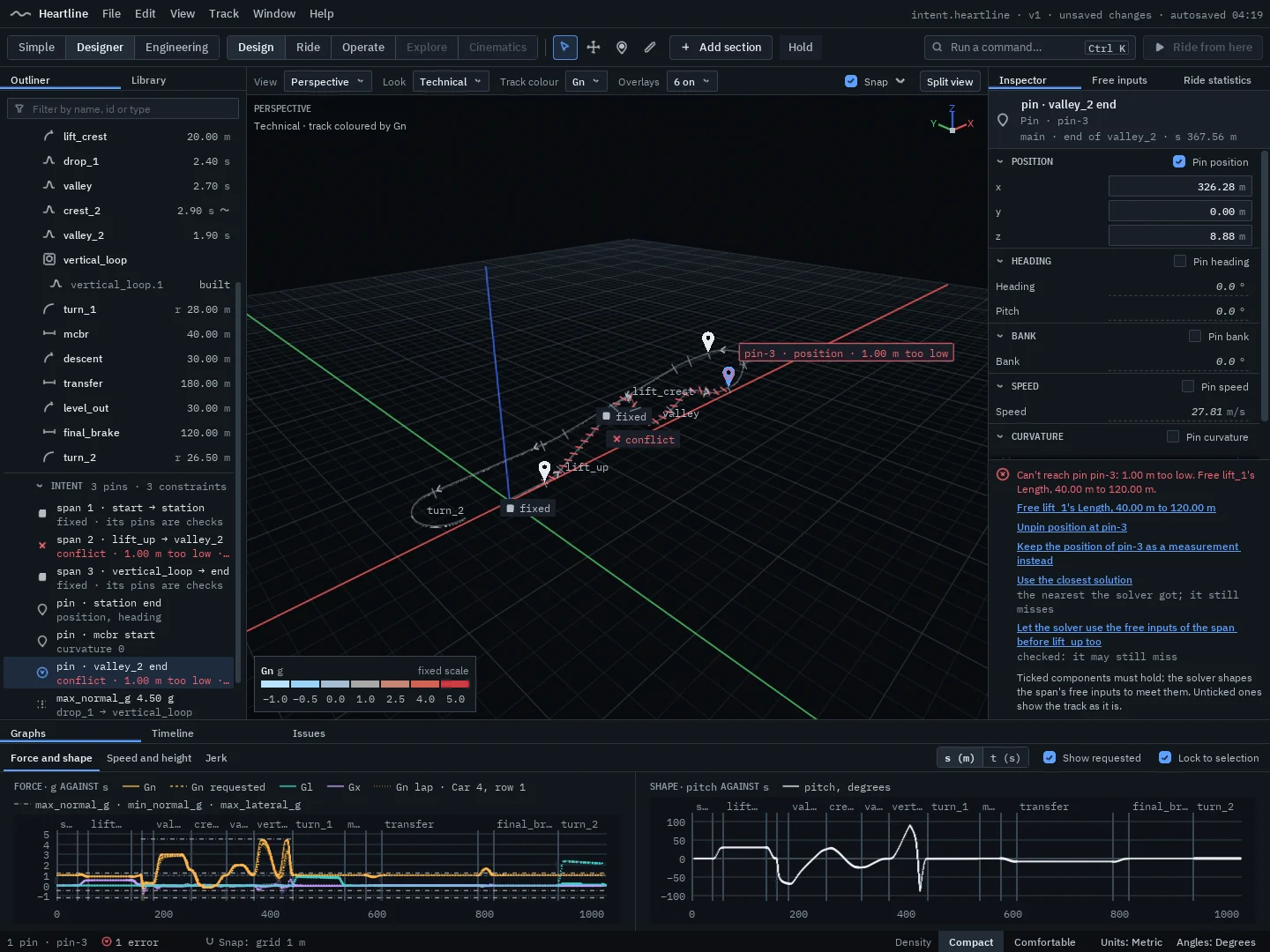 Real screenshot
, in-development build. The design solver in the editor: a conflict, shown on the track and in the intent section, with the solver’s fixes in the inspector. -
Planned
A free community preview, after M5
The plan is to open Heartline to the community once a complete coaster can be designed, ridden and saved: Designer and Simple modes, the simulation and the technical view, so designers can shape what comes next.
-
Phase 6M6 · “Sculpt the site”Planned
Terrain v1
The full first-release terrain: sculpting, 3D shapes, tunnels, splines, materials, water and track-aware tools.
- 3D terrain system
- Brushes and shapes
- Tunnels and trenches
- Site plans
-
Phase 7M7 · “Real coasters”Planned
Coaster types and structure
Seven steel coaster types, at least 20 styles from modular trains, and supports that sit on the terrain.
- Seven coaster types
- 20+ styles
- Modular trains
- Automatic supports
- Catwalks
- Flanges and nodes
-
Phase 8M8 · “It looks real”Planned
Photoreal and scenery
Photoreal stills you’d show an investor: ray-traced light, real materials, sky, weather and scenery.
- Ray-traced lighting
- Time of day and weather
- Scenery library
- Model import
- Quality tiers
-
Phase 9M9 · “A living world”Planned
Experience and sharing
Walk the site, board the train, run it from working panels, film it, hear it, and share it.
- Explore on foot
- Operate
- Cinematics
- Physics-driven audio
- No-code rules
- Telemetry
- Packages and Workshop
-
Phase 10M10 · “Feature complete”Planned
Modes and engineering
All three modes complete, with Engineering mode’s analysis runs, acceleration checks and the design report.
- Simple mode complete
- Engineering mode
- Acceleration checks
- Design report
- Pro edition
-
Phase 11M11 · “H1 released”Planned
Release
Ship it: the parity checklist complete, final performance, installer, help and tutorials, and a closed beta with community designers.
- Parity complete
- Installer and help
- Closed beta
- First public release
Every proposed feature
The first release, the next version, and the long-term vision.
Everything planned, area by area. Anything not in the first release still shapes the design today: Heartline is built so that none of it is ruled out.
The first public release
Everything in development now or planned for the phases ahead. The built features are on the feature list.
Design and the three modes
- Designer mode. Every section type, force and shape graphs, precise numeric editing and the full set of ride hardware. In development
- Simple mode. An element palette of drops, hills, loops, helices and more. Drag to place, joins smoothed for you, a few friendly settings and plain-language feedback. In development
- Templates and examples. Start a new ride from a template, or save your own design as one. In development
- Keyboard first. Shortcuts for everything, remappable, with a Blender-style preset and a typed command line. In development
- The version store. Compare, restore and name saved versions of a design. In development
- Layout-first design. Sketch the footprint and the height profile, and Heartline builds track that follows them. Planned · H1
- Simple mode, complete. Automatic smoothing, a fun and intensity rating that shows where its numbers come from, and guided tutorials. Planned · H1
- Review mode and comments. Comments pinned to places on a design, and a read-only review mode with measuring and compare. Planned · H1
The design solver
- Terrain-aware constraints. Terrain clearance and the site boundary as requirements the solver respects. Planned · H1
Engineering and analysis
- Wheel loads and clearance. Wheel-load envelopes, clearance between tracks and margin colouring while you design. In development
- Measured rides, lined up. Recordings lined up with a design automatically, by distance along the track. In development
- CSV export in every edition. Track points, forces and speeds out to spreadsheets. Track-point export already works in the core. In development
- Acceleration checks. Evaluated as EN 13814 and ASTM F2291 describe: rider axes, the 5 Hz filter, the evaluation points, every seat row, flagged on the track. Limit values stay provisional until checked against the purchased standards. Planned · H1
- Analysis runs in the editor. A queue of analysis runs, each recording the design version, solver settings and standard editions it used. Planned · H1
- The design report. A printable report from an analysis run: provenance, drawings, forces and checks. Planned · H1
- Rider clearance envelopes. Checks of the riders’ clearance envelope against structure, terrain and scenery. Planned · H1
Ride hardware and operations
- Hardware in the editor. Place ride hardware, set up trains and blocks, and configure moving track. In development
- Operate, first version. A generated control panel for each station, manual dispatch and alarms. In development
- Ride devices at real dimensions. Chain links, tyres, calipers, catch cars and stator rows defined by real dimensions, generated along the track and driven only by the simulation. Planned · H1
- Working control panels. Panels from each ride’s own panel data: dispatch, gates, restraints and block control, plus a maintenance mode. Planned · H1
Terrain and the site
- Sculpting brushes. Raise, lower, smooth, flatten and noise, with size, strength and falloff, sculpting in real time. Planned · H1
- 3D shapes. Add or subtract spheres, boxes, cylinders and custom shapes for cliffs, overhangs, caves and rock arches. Planned · H1
- Tunnels. Carved by hand or along a path. Planned · H1
- Splines. For paths, riverbeds, embankments and cuttings. Planned · H1
- Track-aware tools. Automatic tunnels where the track passes through terrain, trenches that follow the track, and flat pads for footers and the station. Planned · H1
- Material painting. Grass, dirt, rock, sand, concrete and more. Planned · H1
- Water. A sea or lake level. Planned · H1
- Non-destructive edits. The terrain is stored as a list of edits, so every edit can be undone and stays adjustable. Planned · H1
- Snap to site drawings. Snap to the lines of vector PDF and DXF drawings, and trace the site boundary from one. Planned · H1
Structure and styles
- Seven coaster types. Sit-down, inverted, floorless, wing, dive, family and launched, each with type-correct forces. Planned · H1
- 20 or more styles. Built from procedural track styles and modular trains, with generic names. Planned · H1
- Modular trains. Bogies, seats, restraints and bodies as parts. Planned · H1
- Engineering-profile styles. Track styles and supports defined as dimensioned engineering profiles, one source of truth for the view and the CAD export. Planned · H1
- Automatic steel supports. Generated to sit on uneven terrain, then fully editable. Planned · H1
- Manual supports and catwalks. Columns, beams, connectors, footers and prefabs, plus catwalks. Planned · H1
- Splice flanges. Split the track into fabrication pieces, with rules for transport length, support nodes and curvature shown as issues. Planned · H1
- Support connection nodes. Where supports attach to the spine, placed by spacing rules and editable by hand. Planned · H1
Scenery and the photoreal look
- The photoreal view. Hardware ray-traced lighting, physically based materials, sky, clouds and time of day. Planned · H1
- Weather. Clouds, fog and rain. Planned · H1
- The built-in library. Trees, rocks and simple buildings, every asset cleared for your commercial use of renders. Planned · H1
- Your own library. Import glTF and FBX models with PBR materials into a library of your own. Planned · H1
- Foliage and paths. Place scenery, paint foliage and lay simple paths. Planned · H1
- High-resolution stills. Screenshots at high resolution, with quality tiers for every machine. Planned · H1
Ride, explore and cinematics
- Explore on foot. Walk the site in first person: under the track, through the station, into the queue, and board the train. Planned · H1
- Basic cinematics. Keyframed camera paths, train- and seat-following cameras, and 4K video capture. Planned · H1
- Physics-driven sound. Wheel, rail, lift, launch and brake sounds driven by the simulation, with 3D positioning, tunnel reverb and ambience. Planned · H1
- Motion-rig telemetry. Telemetry output for motion simulators and dashboards, compatible with existing motion-rig software where the protocol allows. Planned · H1
Import, export and CAD
- NoLimits 2 track import. Designers coming from NoLimits 2 can bring their tracks across: .nl2elem and NoLimits 1 .nlelem element files, and NL2 CSV splines. In development
- NoLimits 2 export. Export to an NL2-compatible track, with a report of what carried across. In development
- CSV points in. Surveyed or hand-calculated layouts: position, banking and optional orientation. In development
- glTF track export. The track as glTF, for other 3D tools. In development
- glTF and FBX models in. Buildings, theming and props from any 3D tool. Planned · H1
Sharing and the community
- Park packages. A site and its custom assets in one file. Built-in assets are referenced, never copied, because everyone already has them. Planned · H1
- Steam Workshop. Share and download parks through Steam Workshop. Planned · H1
- Comments on designs. Comments pinned to places on the track. Planned · H1
- Your work is yours. You will own your designs and renders, including commercial use of renders. The licence terms will set this out. Planned · H1
Automation: Python and AI assistants
- The rules editor. Sensors trigger lights, sounds, animations, effects and ride commands, with no programming. Planned · H1
Platform and VR
- A Windows desktop app. Windows 10 and 11 with mouse and keyboard, windowed or full screen, with standard file dialogs. In development
- Workspaces across monitors. Layouts per mode, saved and restored, across several monitors. In development
- Accessible by design. Full keyboard use, a visible focus ring, and colour never the only signal. In development
The next major version
Automation and AI, VR riding, engineering depth, CAD and BIM exchange, park design basics, more ride types and more.
Design and the three modes
- Convert and reverse. Convert sections between types, and reverse a piece.
- Your own track styles. A style editor for rail profiles and spine shapes.
- Named parameters. Named parameters and live expressions that drive a design.
- Community elements. Elements made and shared by users.
The design solver
- Whole-ride optimisation. “Smooth this whole ride to stay under X g”: goals across an entire ride.
Physics and simulation
- Wind. Wind acting on the train.
- Temperature effects. Cold-running and warm-running trains.
Engineering and analysis
- Recreate a ride. Fit force sections to a recorded ride’s forces.
- Full multibody analysis. Multibody analysis with wheel contact for road, side and up-stop wheels.
- Loads for structural tools. Structural loads, plus wheel and interface load histories exported for structural analysis tools, and track data for multibody tools.
- Fabrication geometry. Rail and spine point and tangent tables at a chosen spacing, with curvature and torsion per segment and explicit units, frame and datum.
- Calculation reports. Printable PDF calculation reports for third-party review.
- Frequency-domain views. Measured against simulated data, in the frequency domain.
Ride hardware and operations
- More moving track. Drop track, vertical lifts, turntables, multi-lane transfers and rotating switches.
- Hydraulic launches and shuttles. Hydraulic launches and shuttle layouts.
- The operations simulator. Faults, e-stops, restraint checks, continuous-loading stations and hourly ride capacity.
Terrain and the site
- Real-world elevation. Start the terrain from the actual site, with DEM and GeoTIFF import.
- Aerial imagery and map data. Aerial and satellite imagery draped over the terrain, and OpenStreetMap roads, buildings and boundaries.
- Point clouds. Drone, LiDAR and laser-scan surveys of a real site (LAS, LAZ and E57).
- Earthworks volumes. How much earth is cut and filled, for cost estimates (Pro).
- Erosion, stamps and rivers. Erosion and weathering brushes, a stamp library, rivers and waterfalls.
Structure and styles
- More coaster types. Flying, stand-up, wild mouse, spinning, suspended swinging and bobsled.
- Wooden and hybrid styles. Wooden and hybrid styles with a wooden support generator.
- The train builder. Build your own trains, and share style packs.
- Walkways and stairs. Evacuation walkways and stairs.
Scenery and the photoreal look
- Full scenery. Theming objects, more model formats and procedural scatter.
- Riders in seats. Riders on the train.
- Park design basics. Several rides in one site, paths and queue lines, buildings, flat-ride placeholders and hourly ride capacity.
Ride, explore and cinematics
- Full cinematics. Multi-shot sequences and path-traced rendering.
- Presentation mode. A guided flythrough with captions, for pitching a ride.
- Sound sets and announcements. Per-style sound sets, a station soundtrack and operator announcements.
Import, export and CAD
- CAD curves. DXF and STEP heartline, rail centrelines and spine, with roll, stating the worst deviation from Heartline’s track (Pro).
- STEP solid bodies. Each rail, tie, spine segment, splice flange, support and base plate as a separate named body in an assembly. Choose what to export and which range. Design-intent geometry, not certified fabrication drawings (Pro).
- Manufacturer track standards. A manufacturer defines its rail, spine, tie and flange profiles once, and Heartline generates detailed geometry for any layout (Pro).
- CAD and survey track in. Track geometry from DXF, STEP and LandXML.
- More model formats. OBJ and USD models, and IFC buildings from BIM workflows.
- Scene export. FBX and USD scenes with the coaster’s motion, for architectural visualisation.
Sharing and the community
- Style packs and elements. Shareable style packs and community-made elements.
- Direct and company licensing. Pro available directly and to companies, for teams that can’t use a store.
Automation: Python and AI assistants
- Python API. Automation, batch work, plugins and company workflows.
- AI assistant connection. An MCP server so AI assistants can read designs, build and edit track, run simulations and explain results, behind a permission prompt, with every edit in the History. A read-only version may come sooner; that’s decided at M5.
Platform and VR
- 3D mice. Support for 3D mice.
- Screen readers. Screen reader support.
- VR riding and exploring. Ride and walk your designs in VR.
The long term
VR building, flexible wooden-coaster physics, full park design, and the next frontier of ride types.
Physics and simulation
- Flexible track and vehicles. Vehicle and track flexibility, needed for true wooden-coaster physics.
Engineering and analysis
- Fatigue estimates. Fatigue estimates from the load histories.
- Design optimisation. Optimisation of a design against engineering goals.
Ride hardware and operations
- Water sections. Splashdowns and boats.
Terrain and the site
- Site-scale terrain. Terrain for whole parks.
- Streamed real-world surroundings. Photoreal streamed 3D surroundings for presentations, subject to the usage terms.
Structure and styles
- The next frontier. 4D and free-fly, water, alpine and multi-dimension coasters.
- Detailed wooden structure. Bents, ledgers and bracing, for flex physics.
Scenery and the photoreal look
- Full park design. Real flat rides, guest flow, sightline and height-limit checks, cost estimates, and site layout from real map data.
Import, export and CAD
- IFC export. Hand the ride over to BIM workflows.
- Live sync with modelling tools. Edit a building in its own tool and see it update in Heartline.
Automation: Python and AI assistants
- Visual node scripting. Node-based scripting for show and ride logic.
Platform and VR
- VR building. Build in VR.
Not planned
So that nobody is surprised:
- Tycoon or park-management gameplay
- Multiplayer
- Consoles and mobile
- Certifying rides
Be there when it lands
Follow along
There’s no mailing list and no sign-up form. If you’d like news about Heartline, want to talk about it, or are interested in trying the community preview when it comes, email us and we’ll keep you in the loop.
We use your email only to reply. See the privacy notice.