
Professionals
Ride designers, engineers and students who need numbers they can trace and reproduce.
A professional roller coaster design and simulation suite for Windows.
Heartline is being built so you can design track by the forces riders should feel, by its shape, or both; simulate the ride in real time; and check the results with the methods the ride standards specify. It is a design tool, built to the standards of professional engineering software, not a game.

Work in progress
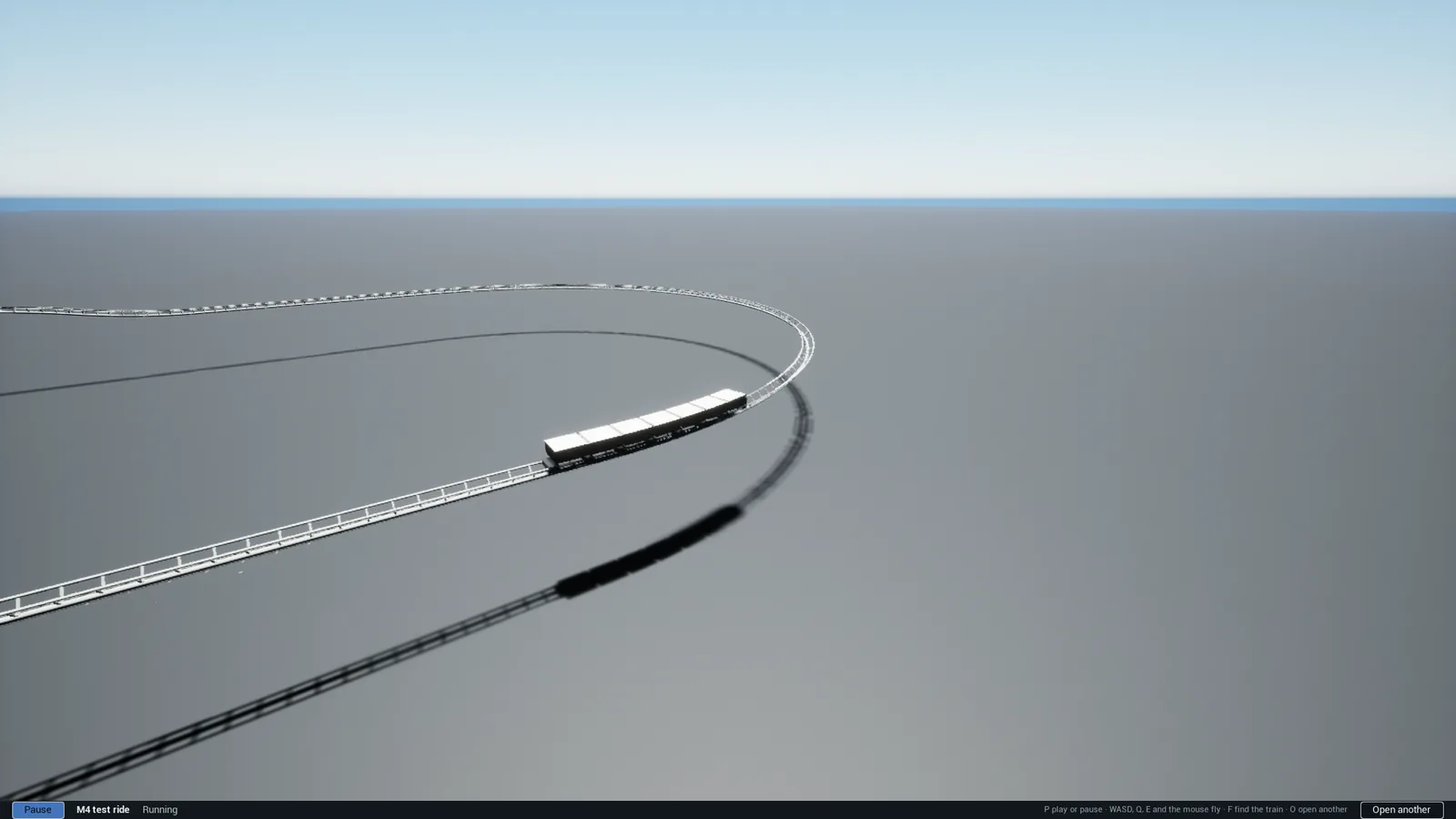
The first train running in Heartline’s own 3D view, driven by the simulation core. The track, train and scene are plain test assets.
Measured, not promised
Figures from Heartline’s own test suite, October 2026, on the development machine.
Positioning
Ride manufacturers use a chain of specialist tools, from concept layout to certification. Heartline is a front-of-process tool: one environment and one physics model for designing a ride, simulating it and presenting it. It is not a certification tool, a structural analysis package or a safety system.
| Stage | Heartline’s role |
|---|---|
| Concept layout | The core of the product: force-based and shape-based track design with design forces. |
| Vehicle dynamics | Real-time simulation of rigid, multi-car trains with loads at every wheel assembly. Good for design decisions, not for engineering sign-off. |
| Ride operations | A simulation of blocks, interlocking, dispatch and operator panels, for checking an operating concept. Not a control or safety system, and never will be. |
| Standards evaluation | The evaluation method the standards describe: rider axes, the 5 Hz filter, every seat row. Limit values are provisional until checked against the published standards. |
| Structure and fabrication | Not covered. Exporting wheel loads and geometry for specialist tools is planned for a later version. |
| Certification | Not covered. Heartline does not certify rides. |
| Presentation | Planned: a photoreal view, rides from any seat, and camera paths for video. |
Who it is for
Simple, Designer and Engineering modes are planned to work on the same file. Switching mode changes the tools on screen, never the track.
Ride designers, engineers and students who need numbers they can trace and reproduce.
People who want full creative control: force-based design, editable graphs and a realistic ride.
Anyone who needs to show a proposed ride convincingly, in a realistic setting.
Anyone who wants to build a ride quickly from ready-made elements, without studying G-forces first.
Heartline’s simulation core is built and covered by several hundred automated tests, run before every change is merged. Most of it has no user interface yet: the editor comes next.
Force-based sections (normal force, lateral force and roll rate) and geometric sections (pitch, yaw and roll), straight and curved sections, transition curves and the heartline offset.
Multi-car trains, including articulated trains, simulated at 1,000 steps a second with rolling and air resistance. Deterministic: the same inputs always give identical results.
Forces at every seat and loads at every wheel assembly, including the impacts where track curvature changes abruptly.
Tyre drives, chain and cable lifts, LSM and LIM launches, eddy-current and friction brakes, trim brakes and anti-rollback.
A general model for track that moves, such as switches: segments with states, routes for every combination of states, and route locking.
Block sections, interlocking, stations, and automatic, manual and grouped dispatch, with design checks. A simulation of the operating concept, not a safety system.
Presence, point and speed sensors driving rules with triggers, conditions and actions, plus timers and operator commands. No scripting needed.
Import of ride recordings (accelerometer data as CSV), the 5 Hz compliance filter, design forces beside simulated forces, and a check that the live simulation agrees with the detailed analysis run.
A versioned, documented .heartline format. Reading a file never crashes the program, and every value the simulation uses is checked before a ride is built.
3D track meshes for a generic steel style, built in sections and rebuilt only where the track changes.
These are goals, not finished features. Plans can change, and items may move between stages as the work proceeds.
Rides opened from a file and run in Heartline’s own window, with cameras and a live readout. In progress now (milestone M4).
The editor: every section type, force and shape graphs edited by dragging, exact numeric input with units, and undo for every action.
Ready-made elements such as loops and airtime hills, placed by dragging and joined smoothly.
A clean, CAD-like view with the track coloured by force on a fixed scale.
Pins (“pass through here, heading this way”), constraints such as force limits and terrain clearance, and a solver that fills in the rest, so you can control forces and position together.
Acceleration checks using the evaluation method of EN 13814 and ASTM F2291, with results flagged on the track. Limits stay marked provisional until checked against the published standards.
Ride in any seat with live forces, run the ride from working control panels, walk the site and board the train.
Realistic lighting, time of day and basic weather; keyframed camera paths and video capture.
True 3D terrain with cliffs, overhangs and caves, and tunnels and trenches that follow the track.
Automatic steel supports that you can then edit, manual supports and catwalks.
Switch tracks, transfer tracks and tilt track, defined as data with no scripting.
At least 20 steel styles across sit-down, inverted, floorless, wing, dive, family and launched coasters, built from modular trains.
Wheel, rail, lift, launch and brake sounds driven by the simulation.
CSV data export in every edition, glTF track export, ride-recording overlays, and import of track from other coaster tools where their formats allow.
Wheel-load histories for structural analysis tools, fabrication geometry, CAD export and printable calculation reports.
A Python API, and a connection that lets AI assistants inspect designs, run simulations and explain results.
An operations simulator with faults and hourly capacity, and riding and exploring in VR.
Heartline helps people design and evaluate rides. It does not certify rides, and it does not replace review by a qualified engineer or an independent inspection body. Heartline is not certified against any standard. Values that relate to EN 13814, ASTM F2291 or other standards are provisional until they have been checked against the published texts.
Coming soon
Builds will appear on the downloads page when the community preview is ready. News will be published on this site.